
The Resilience Paradox
What happens when we get better at living with the things we should be trying to change?

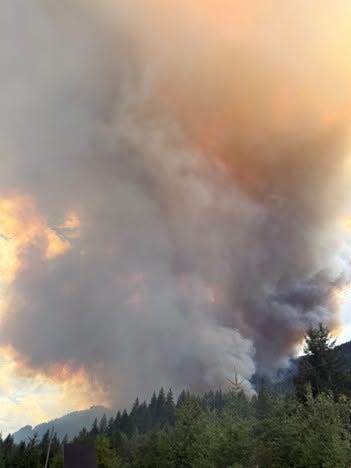
I’m writing from our little cabin in the woods on a small island on the west coast of Canada.
More than 900 wildfires are burning across the country. Thousands of people have been evacuated from their homes, many from remote and First Nations communities. Firefighters, aircraft and equipment are moving across provincial and international borders as communities compete for increasingly stretched resources.
Meanwhile, wildfires in France and Spain have forced more than 300,000 people from their homes.
And it’s still July.
Climate change didn’t light these fires, but scientists have been clear that a warming climate created hotter, drier conditions that allow fires to start more easily, spread faster, burn hotter, last longer and become more difficult to control.
None of this is new. We’ve understood the relationship between greenhouse gases and a warming planet for decades. What’s remarkable is that most of us just carried on and didn’t do much about it.
Katharine Hayhoe says that one of the central problems of climate change is our difficulty responding to gradual changes. Her familiar metaphor is that we’re like frogs in boiling water.
Our predicament is stranger than that, because we can see the thermometer. We know the temperature is rising. We’re measuring it, forecasting it and mapping its consequences. We’re building increasingly sophisticated systems to protect ourselves from what those rising temperatures mean.
Which brings me to preparedness.
I’ve been spending a lot of time thinking about this and what it all means: wildfires, heat domes, evacuations, emergency communications, neighbourhood resilience, and what happens when professional responders are overwhelmed, and communities have to rely, at least temporarily, on themselves.
Living on a small island has something to do with it, as we have one ferry and one road that takes us to it. In an emergency, particularly one affecting the entire island, there is no guarantee we’ll be able to leave, or that help will arrive immediately. And if the same emergency is affecting Vancouver and the surrounding region, getting off the island may not be the safest option anyway.
I’ve been talking with firefighters, emergency managers, researchers, psychologists, elected officials and people involved in coordinating wildfire resources across Canada to understand these issues better. The more I learn, the more convinced I am that we need to be better prepared. One fire chief put it more starkly: “As a society we have never been less prepared for the threats in front of us.”
That’s a sobering thought. Particularly when we’ve never known more about the threats we’re facing.
Which raises a more uncomfortable question:
Are we becoming better at managing the consequences of climate change than addressing its causes?
Canada has failed to meet every major national emissions target and, according to the federal government’s latest projections, is not on track to meet its 2030 target. British Columbia has repeatedly fallen short of its own targets. Yet governments continue to approve and support new fossil-fuel infrastructure, including pipelines and LNG projects, arguing that they create jobs, generate public revenue and contribute to economic growth.
In Alberta, a proposed $70-billion AI data-centre development, intended to become the largest in the world, would begin with its own 1.4-gigawatt power system drawing on natural gas and geothermal energy. That’s an enormous amount of power—roughly comparable to the electricity demand of Edmonton, a city of about 1.2 million people.
None of these decisions exists in isolation. Each can be defended economically. However, together, they reveal the uncomfortable contradiction.
We acknowledge the science. We set targets for reducing emissions. We warn that climate change is contributing to longer fire seasons, more extreme heat, drought, flooding and other disasters. And then we continue making economic decisions that make those emission targets increasingly difficult if not impossible to reach.
And perhaps most unsettling, these decisions are not necessarily being made by people who reject climate science. Governments can acknowledge the danger, promise to reduce emissions and invest billions preparing for the consequences while simultaneously supporting economic choices that contribute to the problem.
We’ve built systems with enormous momentum that no one seems capable of changing.
Years ago, I interviewed Roy Scranton about climate change. He said something I’ve never forgotten: “No one is driving the car.” I’m beginning to understand what he meant.
Governments know the planet is warming. Scientists know. Oil companies know. Most of us know. Exxon’s own scientists were modelling global warming as far back as the late 1970s. We have international conferences, emissions targets, climate plans, carbon budgets and decades of increasingly precise warnings about where we’re headed.
And still, emissions are rising.
No one wakes up in the morning and decides to make the planet hotter. But governments, industries and all of us make decisions every day that collectively keep taking us in that direction. We approve projects, protect industries, consume energy and prioritize economic growth, even as we promise to reduce emissions.
Meanwhile, another part of government is being asked to prepare us for the consequences with more firefighters, more aircraft, more FireSmart projects, more emergency planning, more evacuation capacity and more money to rebuild what’s lost.
That’s the paradox we need to confront.
What happens when we become increasingly good at living with something we’re failing to stop?
In a 2019 study of people who had experienced severe flooding in the UK, psychologist Charles Ogunbode and his colleagues gave this tension a name: “the resilience paradox.”
They found that people who felt more capable of coping with the consequences of flooding experienced less negative emotion about climate change. On the surface, that sounds like resilience doing exactly what we want it to do.
But there was a catch.
As people became better at coping with the consequences, the emotional response that might motivate them to address the cause also weakened.
In other words, becoming better at living with climate change may make us less inclined to do something about it.
None of this necessarily means we don’t understand what’s happening. Sometimes it means precisely the opposite. We know enough to understand that looking directly at something may require more of us than we’re ready to give.
David Whyte helped complicate my understanding of denial as I’d always thought of it as a failure: ignorance, dishonesty, a refusal to acknowledge something obviously true. Whyte saw something more human in it. He describes denial as having a merciful quality, capable of protecting us until we’re psychologically able to confront something we cannot yet absorb.
Denial, in this sense, isn’t always the absence of knowledge. Sometimes we know. We simply can’t bear the full implications of what we know. There is mercy in that. But there is also danger if temporary protection becomes a permanent way of living. Climate change may confront us with a version of the same problem on an almost unimaginable scale.
Preparedness offers a way of seeing this more clearly.
Jonathan Eaton and his colleagues at UBC’s Disaster Resilience Research Network recently asked thousands of Vancouver residents how they think about disaster risk and preparedness. What interests me about their findings is that the problem isn’t simply that people don’t care.
People are concerned. Many want to be better prepared. But wanting to prepare and actually preparing are different things. People encounter practical barriers such as time and resource constraints, uncertainty about what to do, and difficulty finding useful information with so much available.
Eaton’s work also points toward something we sometimes overlook when we talk about emergency kits and evacuation routes: that preparedness is social. Knowing that you can count on your neighbours matters. Trust matters. Connection matters.
This resonates with me because much of my research has taken me to a similar place but from a very different direction. I’ve spent years thinking about dialogue and relationality — not simply whether we listen to one another, but what happens when the things we hear challenge our identities, our interests or the stories we tell ourselves about the world. Those are often the moments when listening becomes hardest, and trust begins to disappear.
Climate change may be an extraordinary example of this. It asks us to confront not only what is happening to the planet but our own relationship to it — the cars we drive, the energy we use, the things we consume, the economies we’ve built and the comforts we don’t particularly want to give up.
Emergency preparedness makes that much less abstract. In a disaster, relationships become infrastructure. Knowing your neighbours, knowing who may need help and believing that those closest to you will show up matters. Perhaps resilience isn’t simply something individuals possess. It’s something we build between us.
There is also another psychological barrier here.
Preparing for an emergency requires us to imagine the emergency. Making an evacuation plan means confronting that we might actually have to use it and leave. Preparing for it means imagining what it could do to our home, our family, and our community.
Human beings cannot remain in a state of permanent alarm. Yet climate change is already creating a considerable amount of it. Research suggests that roughly four in ten Canadians are very or extremely worried about climate change, while about three in ten report feeling anxious or overwhelmed by it.
But we still have to live our lives. We go to work, make dinner, take care of the people around us and find some version of normal. In grief and temporary emergencies, that capacity to adapt can help us survive. But what happens when the crisis doesn’t end?
Adaptation happens in another way too. We don’t simply adjust psychologically to a changing world. We change the world around us so we can live in it.
There is something seductive about that kind of adaptation. It’s tangible. It produces things we can see: new firefighting aircraft, a wider firebreak, a strengthened dike, a cooling centre, an emergency alert system. Governments can announce them. Communities can photograph them. Budgets can measure them.
And we need those things. They make communities safer and help us cope with conditions that are already changing. The trouble is that becoming better at dealing with the consequences isn’t the same as addressing what’s causing them.
When I spoke with B.C. Forests Minister Ravi Parmar this week, he described what years of increasingly intense wildfire seasons have done to the province. “We’ve just become good at it because we’ve had to!”
And perhaps that’s adaptation in its simplest form.
Mitigation is harder. A tonne of carbon not emitted doesn’t make much of a ribbon-cutting ceremony. Its benefits accumulate slowly and globally, while reducing emissions asks uncomfortable questions about energy, transportation, consumption, industry and economic growth.
And that’s part of the problem. For all the attention we give to the consequences of climate change, we don’t spend nearly as much time talking about what it would actually take to address its causes. We talk about fires, evacuations, smoke, aircraft and firefighting resources. We talk about preparedness and rebuilding. But the larger climate conversation has slipped into the background.
When Roy Scranton and I spoke, he had largely given up trying to change people’s minds about climate change. He doubted there was some perfect argument or missing fact that would suddenly make us act. I found that bleak then, and I still do. The problem isn’t that we haven’t found the right argument. It’s more likely that we no longer know what to say to one another, or how to say it.
And knowing about something isn’t the same as doing something about it.
The planet is getting hotter. Our forests are burning. Smoke travels thousands of kilometres, turning distant skies orange. Communities evacuate, rebuild and sometimes evacuate again. What we once called extraordinary increasingly arrives as just another summer.
And we carry on.
Perhaps that’s what I find most unsettling about our ability to adapt. We don’t have to deny what’s happening. We can know perfectly well what’s happening and still learn to live with it. I can’t help but wonder how many other things in our lives are like this.
A relationship changes, and we avoid the conversation. A friend slowly disappears from our life, and we tell ourselves we’ll call next week. We step around someone sleeping on the sidewalk and eventually stop noticing that they’re there. Another war begins somewhere else. Another community burns. Another family is evacuated. Political behaviour that might once have appalled us becomes something we scroll past between dinner and the weather.
Perhaps that’s the part that’s hardest to admit. Human beings can get used to almost anything.
Not because we don’t care. But because caring about everything, all the time, would make it impossible to live.
Whyte’s idea that denial can sometimes be merciful comes back to me here. We can’t carry the full weight of everything that frightens or troubles us all the time. Sometimes we have to put something down for a while and make dinner, go to work, take a walk, or laugh with someone we love.
But there is a difference between putting something down and forgetting to pick it back up.
Not that we don’t see what’s happening.
That we get used to it.
References and suggested reading or listening
Angus Reid Institute. (2026, July 20). Wildfire fears burn hot, even as belief in human-caused climate change continues to decline. https://angusreid.org/wildfire-fears-burn-hot-even-as-belief-in-human-caused-climate-change-continues-to-decline/
Eaton, Jonathan, Raahina Somani, Hang Cheng Ip, Michael Hooper, Theodore Lim, and Sara Shneiderman. (2025). Understanding Disaster Preparedness in Vancouver: Community Perspectives. UBC Disaster Resilience Research Network and City of Vancouver Emergency Management Agency.
Government of Canada. 2025 Progress Report on the 2030 Emissions Reduction Plan
Ogunbode, Charles A., Gisela Böhm, Stuart B. Capstick, Christina Demski, Alexa Spence, and Nicole Tausch. (2019). “The resilience paradox: flooding experience, coping and climate change mitigation intentions.” Climate Policy, 19(6), 703–715.
Parmar, Ravi. (2026, July 27). Interview with Don Shafer for The Conversation Lab. Unpublished interview.
Scranton, Roy. (2015). Learning to Die in the Anthropocene: Reflections on the End of a Civilization. City Lights Books.
Supran, G., Rahmstorf, S., & Oreskes, N. (2023). “Assessing ExxonMobil’s global warming projections.” Science, 379(6628), eabk0063. DOI: 10.1126/science.abk0063.
Whyte, David. (2014). “Denial.” Consolations: The Solace, Nourishment and Underlying Meaning of Everyday Words. Many Rivers Press.
The Conversation Lab with Katharine Hayhoe.
The Conversation Lab with Roy Scranton and Al Gore.
A note on where this is going: I’ve been talking with people who approach wildfire, preparedness and resilience from many different places and perspectives. Those conversations are finding their way into my writing and will also become part of upcoming episodes of The Conversation Lab.
If this essay starts a conversation for you, I hope you'll continue it—whether by leaving a comment or sharing it with someone else.
Thanks for sharing Kevin.
Well written Don. Very thought provoking indeed